

Custom Packaging Solutions
Premium quality packaging tailored to your brand. From cosmetic boxes to luxury rigid packaging, we deliver excellence since 2010.
This is the title

Hey there, I'm Mike!
Where can I find silk screen supplies1 in China?
You need quality screen printing supplies but sourcing from China is a maze. You face language barriers, quality control issues2, and confusing logistics3, which puts your entire production schedule at risk.
For reliable silk screen supplies1 in China, focus on established manufacturers4 on platforms like Alibaba5 or specialized industry hubs in cities like Shenzhen6 and Dongguan7. Vet them by checking reviews, asking for samples, and verifying certifications8.
<sup id=](https://wansapackaging.com/wp-content/uploads/2025/10/where-can-i-find-silk-screen-supplies.jpg) 9s." title="Sourcing Silk Screen Supplies in China" />
9s." title="Sourcing Silk Screen Supplies in China" />
Before I started Wansa Packaging, I spent years working with different printing methods on the factory floor. Silk screening was one of the first techniques I mastered. It's an art form, but it relies on good science and, most importantly, good tools. I learned that the quality of your ink, the tension of your screen, and the edge of your squeegee9 directly impact the final product. Sourcing these supplies isn't just about finding the cheapest option; it's about finding a reliable partner who provides consistent quality. This foundation is essential, whether you're printing a simple logo on a box or a complex design on a luxury shopping bag.
What supplies do I need for screen printing?
You want to start screen printing, but the long list of required gear is confusing. This uncertainty keeps you from taking the first step and bringing your custom packaging10 designs to life.
The essential supplies are a screen with a frame, a squeegee9 to push the ink, photo emulsion11 and a light source to create your stencil, and the specific screen printing ink12 for your material.
<sup id=](https://wansapackaging.com/wp-content/uploads/2025/10/what-supplies-do-i-need-for-screen-pr.jpg) 9, and pots of ink." title="Essential Screen Printing Supplies" />
9, and pots of ink." title="Essential Screen Printing Supplies" />
When we set up a new silk screening station at our facility, we start with the basics. It's a simple process at its core, but every piece of equipment has a critical role. Think of it like cooking: you need the right pan, the right spatula, and the right ingredients. For a designer like Jacky looking to prototype a new box design, having these core supplies allows for quick, hands-on experimentation. The initial setup might seem like a lot, but once you have the core tools, you only need to restock the consumables like ink and emulsion.
Core Equipment Breakdown
These are the non-negotiables you need to get started.
- Screen and Frame: The screen is a mesh stretched over a wood or aluminum frame. The mesh count13 (threads per inch) determines the level of detail you can achieve. A lower number is for bold graphics, a higher number for fine details.
- Squeegee: This rubber blade pushes ink through the screen's stencil. The durometer (hardness) of the blade affects how much ink is deposited.
- Photo Emulsion & Scoop Coater: Emulsion is a light-sensitive chemical you spread on the screen with a scoop coater. When exposed to UV light, it hardens, creating the stencil for your design.
- Ink: Specially formulated inks are needed. There are water-based inks14 for paper and fabric, and solvent-based or UV-cured inks for plastics and metals.
What materials are used in silk screen printing?
You think screen printing is only for t-shirts. This narrow view limits your creativity and prevents you from applying this versatile printing method to your unique packaging needs.
Silk screen printing is incredibly versatile. It works beautifully on paper and cardboard for boxes, plastic films for bags, as well as wood, metal, glass, and fabrics.
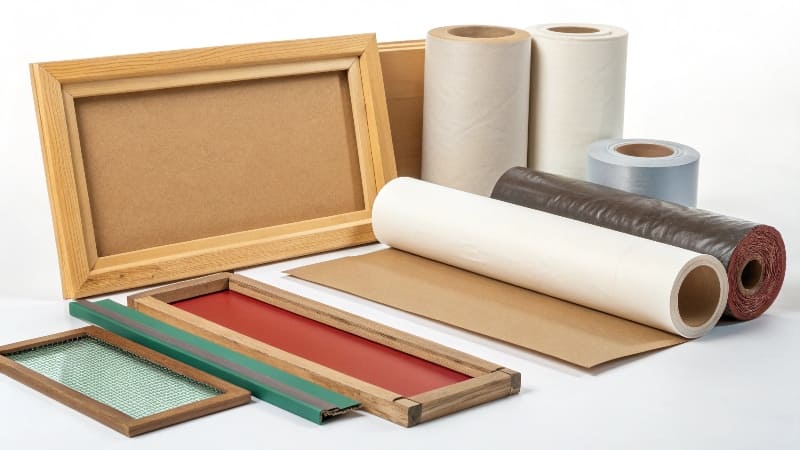
This is one of my favorite topics because it shows the true power of this technique. Early in my career, I was amazed at the range of products we could print on. My key insight is that materials like paper and plastic films can be used for silk screening. This makes it a perfect choice for custom packaging10. We can print a bold logo on a corrugated shipping box, an elegant pattern on a fine paper shopping bag, or instructions on a clear plastic insert.
The process involves forcing ink through a stencil directly onto the surface. As long as the surface is relatively flat and can accept the ink, you can probably screen print on it. This flexibility is invaluable.
| Material Category | Examples | Best For |
|---|---|---|
| Paper & Board | Cardboard boxes, paper bags, rigid box wraps | Logos, branding, decorative patterns |
| Plastics | Poly mailers, PVC sheets, cosmetic tubes | Bold graphics, simple text |
| Fabrics | Tote bags, ribbon, cloth pouches | T-shirts, promotional items |
| Rigid Surfaces | Wood, metal panels, glass bottles | Specialty products, signage |
Which is cheaper, DTF15 or Silkscreen?
You need to choose a printing method, but the costs are confusing. Picking the wrong one means either overpaying for a large batch or making small, custom jobs completely unprofitable.
Silkscreen is significantly cheaper per item for large runs (over 50 pieces). Direct-to-Film (DTF15) is cheaper for single a-la-carte items or very small runs with many colors.
<sup id=](https://wansapackaging.com/wp-content/uploads/2025/10/which-is-cheaper-dtf-or-silkscreen-.jpg) 15 printer, with cost symbols." title="Cost Comparison: [DTF](https://ninjatransfers.com/pages/dtf-vs-screen-printing?srsltid=AfmBOoqdvQToSehrorovTql9lqwoZtrNA3ua8o_COVkR3yFu-Bdpp3Ng)15 vs. Silkscreen" />
15 printer, with cost symbols." title="Cost Comparison: [DTF](https://ninjatransfers.com/pages/dtf-vs-screen-printing?srsltid=AfmBOoqdvQToSehrorovTql9lqwoZtrNA3ua8o_COVkR3yFu-Bdpp3Ng)15 vs. Silkscreen" />
Understanding the cost structure is crucial for any business. I've often seen clients choose the wrong method and waste money. It's important to know that the cost of silk screening is much cheaper than traditional offset printing for certain jobs, and the same logic applies when comparing it to digital methods like DTF15. The key difference is the setup cost.
I always explain it this way: Silk screening is different from offset printing; it uses a screen to directly apply the output . With silkscreen, you have to create a separate screen for each color in your design. This initial setup has a fixed cost. Whether you print 10 boxes or 1,000 boxes, you still have to make those screens. For DTF15, there's almost no setup; you just print the design from a computer. This makes DTF15 great for one-offs. But once you hit a higher quantity, the low cost of ink and high speed of silkscreen printing make it far more economical per piece. The setup cost gets spread out over many items, making each one very cheap.
How to silk screen for beginners?
You're eager to try silk screening, but the process looks complicated. You're afraid you'll make a mess, waste expensive materials, and end up with a blurry, unusable print.
Start by creating your stencil on a coated screen using light-sensitive emulsion. Once the stencil is ready, lay the screen on your material, apply a line of ink, and pull it across firmly with a squeegee9.
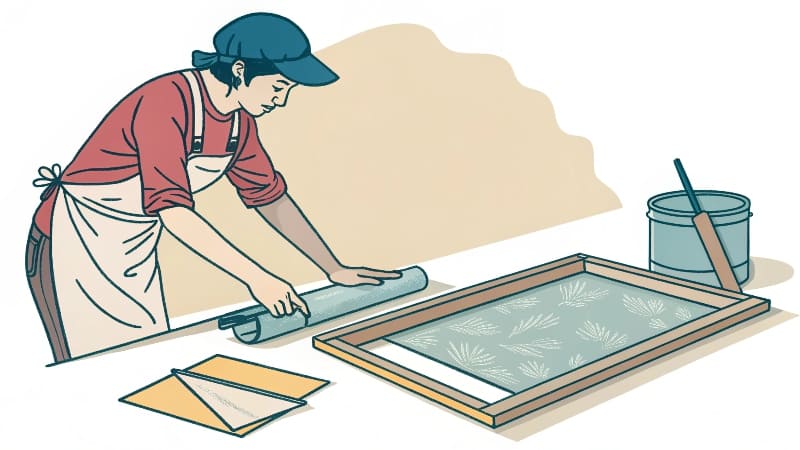
I have trained many new workers on the basics of screen printing, and I always teach them the same four core steps. Breaking it down makes it much less intimidating. It's a methodical process where each step builds on the last. If you get the steps right, you get a great print. It's that simple. Let’s walk through a basic project, like printing a logo on a flat piece of cardboard.
A Beginner's Four-Step Guide
- Prepare the Stencil: First, print your design in solid black onto a clear transparency film. Next, in a dark room, coat your screen with a thin, even layer of photo emulsion11. Let it dry completely.
- Expose the Screen: Place your transparency on the dried screen and expose it to a strong UV light source. The light hardens the emulsion everywhere except where your black design blocks it.
- Wash Out the Design: After exposure, wash the screen with water. The unhardened emulsion behind your design will wash away, leaving a clean stencil of your image in the mesh.
- Print Your Image: Lay the screen flat on your cardboard. Pour a line of screen printing ink12 above your design. With your squeegee9 held at a 45-degree angle, pull the ink firmly and evenly across the stencil. Lift the screen, and your print is done!
Conclusion
Finding the right silk screen supplies1 from China involves partnering with vetted suppliers. This ensures you get the quality tools needed for this versatile, cost-effective printing method for your packaging.
Explore this link to discover trusted suppliers and manufacturers for silk screen supplies in China. ↩
This link offers strategies to mitigate quality control issues in your sourcing process. ↩
Understand the logistics involved in sourcing supplies from China to streamline your process. ↩
Learn about reputable manufacturers that ensure quality and reliability for your screen printing needs. ↩
This resource provides tips on navigating Alibaba to find quality silk screen supplies. ↩
Discover the best locations in Shenzhen for sourcing high-quality silk screen supplies. ↩
Find out why Dongguan is a hotspot for silk screen supplies and how to leverage it. ↩
Learn how to check supplier certifications to ensure quality and compliance. ↩
This resource provides insights on selecting the right squeegee for optimal results. ↩
Discover how screen printing can elevate your custom packaging projects. ↩
Learn about selecting the best photo emulsion for your screen printing projects. ↩
Explore the various types of screen printing inks suitable for different applications. ↩
Discover the importance of mesh count in achieving desired print quality. ↩
Explore the advantages of water-based inks for eco-friendly screen printing. ↩
Understand the key differences between DTF and silk screen printing methods. ↩
More to read
# Which is Better for Packaging Mockups: Laser or Inkjet?
Which is Better for Packaging Mockups: Laser or Inkjet? You need to create a physical
2025 year the most welcome packaging box color trends
This year, packaging trends are making a bold statement with Radiant Red taking the limelight
5 Important Things to Consider for Luxury Products Packaging?
5 Important Things to Consider for Luxury Products Packaging? You've created a premium product, but