

Custom Packaging Solutions
Premium quality packaging tailored to your brand. From cosmetic boxes to luxury rigid packaging, we deliver excellence since 2010.
This is the title

Hey there, I'm Mike!
What is the first step to order paper packaging boxes1?
You're excited to get custom boxes2 for your product, but the path from idea to finished box seems foggy. You're worried about missteps, like ordering the wrong size, which could waste a lot of time and money.
The absolute first step to order paper packaging boxes1 is to have your final, finished product in hand. Before you can decide on box size3, structure, or design, you must know the exact dimensions4 and weight of what's going inside.
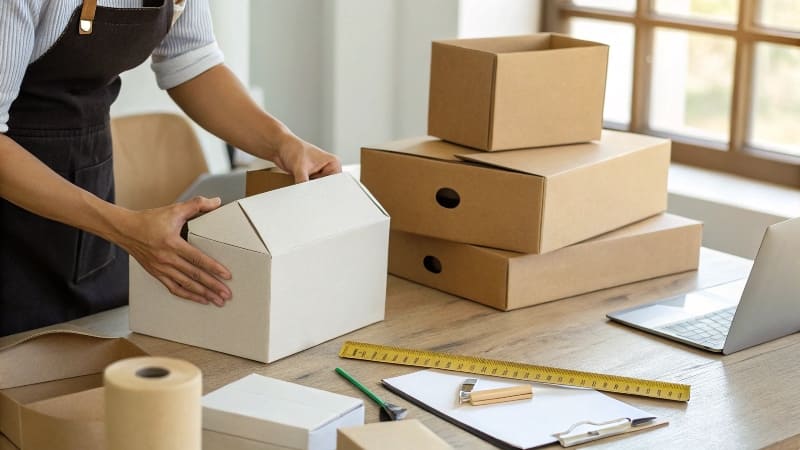
It sounds almost too simple, but it is the golden rule of packaging. I've seen clients try to design a box based on a prototype, only to have the final product change by a few millimeters. That small change can make thousands of boxes completely useless. To avoid this, you must treat the product as the foundation. Everything—the fit, the protection, the unboxing experience5—is built upon it. Let's walk through how to build your box correctly, starting with that foundation.
How to make your own packaging box from scratch?
You want to create unique packaging, but don't know the professional steps. You're trying to move beyond DIY solutions to something that is scalable, protective, and looks amazing.
To create a professional box from scratch, you first measure your final product. Next, you or a designer creates a 2D technical drawing called a "die-line6." Finally, you apply your graphics to this template and send it to a manufacturer.
<sup id=](https://wansapackaging.com/wp-content/uploads/2025/09/how-to-make-your-own-packaging-box-fr.jpg) 6 for a box." title="Creating a Custom Box Die-Line" />
6 for a box." title="Creating a Custom Box Die-Line" />
I believe the first step in ordering paper boxes is to have your product ready. Once the product is ready, you can decide on the size of the box. With the box dimensions, you can decide on the structure, and then draw the die-line6 to create the box . This die-line6 is the architect's blueprint for your package. It tells my machines exactly where to cut and where to fold. It is the most critical technical document in the entire process. Without a correct die-line6, we simply cannot make a box that fits your product perfectly.
Step-by-Step Box Creation
- Finalize Product: Have the exact product you plan to ship. No prototypes.
- Define Dimensions: Carefully measure your product's Length, Width, and Height. Add 1-3mm to each dimension for a snug, yet easy-to-remove fit.
- Choose a Structure: Is it a simple product box (folding carton)? A sturdy shipping box (mailer)? Or a luxury gift box7 (rigid box)? Your choice depends on your product's value and how it will be sold.
- Create the Die-line: A packaging designer8 creates this vector file (usually in Adobe Illustrator). It lays your box out flat and defines all cuts and creases.
- Apply Graphics: Your designer places your logo, colors, and text onto the die-line6 template.
- Submit for Manufacturing: You send the final die-line6 and artwork files to a manufacturer like me to start production.
How much does it cost to make a cardboard box?
You need to create a budget for packaging, but the costs you hear about are all over the map. You're afraid of getting a quote that's too high or, worse, a cheap quote that hides future costs.
A custom cardboard box can cost anywhere from $0.20 for a very simple, large-quantity box to over $5.00 for a complex, low-quantity rigid box. The final price is determined by quantity, size, material, and printing complexity9.
<sup id=](https://wansapackaging.com/wp-content/uploads/2025/09/how-much-does-it-cost-to-make-a-cardb.jpg) 2, implying cost calculation." title="Cost to Make a Cardboard Box" />
2, implying cost calculation." title="Cost to Make a Cardboard Box" />
This is the number one question everyone asks. The answer is always: "it depends." We decide on the box structure and materials based on your budget. The single biggest factor that influences the per-box price is quantity. Setting up the printing press and the cutting die has a fixed cost. If we spread that setup cost over 10,000 boxes, the cost per box is very low. If we spread that same setup cost over only 500 boxes, the cost per box is much, much higher. After quantity, the material choice10, the number of colors you print, and any special finishes11 like foil stamping will also have a big impact on your final price.
Key Factors Affecting Box Cost
| Factor | Impact on Price | Why it Matters |
|---|---|---|
| Order Quantity | Very High | Spreads fixed setup costs (plates, dies) over more units, lowering the per-piece price. |
| Box Size | High | A larger box uses more raw material, which directly increases the cost. |
| Material Type | Medium | Rigid board is more expensive than corrugated, which is more expensive than simple paperboard. |
| Printing | Medium | Printing one or two colors is cheaper than full-color (CMYK) printing. |
| Special Finishes | High | Foil stamping, embossing, and special coatings add machine time and material costs. |
What type of paper is used for box packaging?
You hear words like paperboard, corrugated, and rigid board12 thrown around. It's confusing, and you're not sure which one provides the right balance of protection and quality for your product.
Lightweight product boxes use folding paperboard (cardstock). Shipping boxes use stronger corrugated board13. High-end luxury products use thick, non-bending rigid board12 for a premium feel and maximum protection.
<sup id=](https://wansapackaging.com/wp-content/uploads/2025/09/what-type-of-paper-is-used-for-box-pa.jpg) 13, and thick [rigid board](https://wansapackaging.com/luxurious-finishes-for-custom-rigid-boxes-that-stand-out/)12." title="Types of Paper for Box Packaging" />
13, and thick [rigid board](https://wansapackaging.com/luxurious-finishes-for-custom-rigid-boxes-that-stand-out/)12." title="Types of Paper for Box Packaging" />
Choosing the right material is about matching the paper to the job. You wouldn't ship a heavy glass jar in a thin paperboard box. In my factory, we work with three main categories of paper. Generally, we use rigid board12 for gift boxes, and corrugated paper or paperboard for colored boxes. Gift boxes look more high-end, while colored boxes and paperboard boxes look more ordinary . A sturdy rigid box tells the customer that what's inside is valuable. A simple folding "color box" is perfect for an item that will sit on a retail shelf.
Common Paper Types Explained
- Paperboard (or Folding Carton): This is a high-grade paper that is thicker than normal paper but still thin and flexible. Think of a toothpaste box or a cosmetic carton. It prints beautifully and is ideal for lightweight items that are displayed on shelves.
- Corrugated Board: This is the material everyone calls "cardboard." It has a wavy sheet of paper (the "flute") glued between two flat sheets14. This structure makes it very strong but lightweight. It's the standard for e-commerce shipping mailers and subscription boxes.
- Rigid Board (or Greyboard): This is highly compressed paperboard that is very thick and does not fold. Think of the box for an iPhone or a luxury watch. To make a box, we wrap this strong board with a thin, beautifully printed paper. It offers the best protection and a premium, heavy feel.
What is the process of cardboard packaging?
You've submitted your design files to the manufacturer. Now what? The production process feels like a mysterious black box, and you're anxious to know how your digital file becomes a physical reality.
The process starts with pre-press checks15 on your files. Then, large flat sheets14 are printed. After printing, they are die-cut into shape and creased. Finally, the flat cutouts are folded and glued into their final box form.
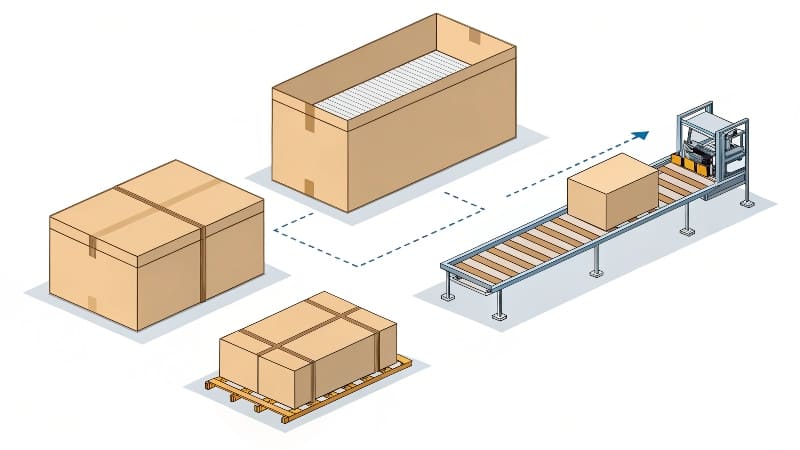
Once your design files arrive, my team gets to work. It's a precise, multi-step process. First, our pre-press experts review your die-line6 and artwork to catch any potential problems before we go to print. Based on the die-line6 dimensions, we can create the final printing documents . Then, we move to the factory floor. We make metal plates for each of your print colors and load them into a massive offset printing press. Large sheets of your chosen paper run through the press at high speed. After printing and any finishes (like lamination), we use a custom cutting die to cut out the flat shape of your box. Finally, those flat pieces go to a folding and gluing machine that assembles them, and then they are packed flat for shipment to you.
Conclusion
The first and most important step is to have your finished product ready. This single action determines your box size3, guides the creation of the die-line6, and ensures an accurate, cost-effective manufacturing process16.
Explore this link to understand the essentials of ordering paper packaging boxes effectively. ↩
This resource will guide you through the process of designing and ordering custom boxes. ↩
Learn about the critical factors that influence box size for your products. ↩
Discover why knowing exact dimensions is crucial for effective packaging solutions. ↩
Discover tips to create a memorable unboxing experience for your products. ↩
This link explains the significance of a die-line in creating custom packaging. ↩
Explore the characteristics that make a gift box luxurious and appealing. ↩
Find out the role of a packaging designer in the box creation process. ↩
Understand how the complexity of printing can influence your packaging budget. ↩
This resource will help you choose the right materials for your packaging needs. ↩
Discover the different special finishes available for enhancing your packaging. ↩
Learn about rigid board and its applications in high-end packaging. ↩
Explore the uses and benefits of corrugated board in packaging solutions. ↩
Explore the role of flat sheets in the production of packaging boxes. ↩
Learn about the importance of pre-press checks in ensuring quality packaging. ↩
Explore the step-by-step manufacturing process of cardboard boxes. ↩
More to read
# Which is Better for Packaging Mockups: Laser or Inkjet?
Which is Better for Packaging Mockups: Laser or Inkjet? You need to create a physical
2025 year the most welcome packaging box color trends
This year, packaging trends are making a bold statement with Radiant Red taking the limelight
5 Important Things to Consider for Luxury Products Packaging?
5 Important Things to Consider for Luxury Products Packaging? You've created a premium product, but