

Custom Packaging Solutions
Premium quality packaging tailored to your brand. From cosmetic boxes to luxury rigid packaging, we deliver excellence since 2010.
This is the title

Hey there, I'm Mike!
How to make sure my boxes are sturdy while shipping them?
You've created the perfect product and beautiful packaging. But you have a nagging fear that it will all be ruined by a careless toss in a delivery truck, resulting in costly returns.
To ensure your boxes are sturdy, you must select a box with the correct strength rating1, use the smallest size that fits your product with padding, and seal it securely with quality packing tape.
After spending years in the packaging industry, I know that a box arriving safely is not an accident. It's the result of smart, deliberate choices made before the box ever leaves the warehouse. Too many brands focus only on the visual design and forget that a box's first job is to protect what's inside. A damaged product is more than just a financial loss; it's a broken promise to your customer. I'm going to walk you through the key steps I teach my clients to make sure their products arrive in perfect condition, every single time.
How to reinforce a box for shipping?
Your standard box feels a little flimsy for the item you're sending. A single drop in transit could break your product and shatter your customer's trust in your brand.
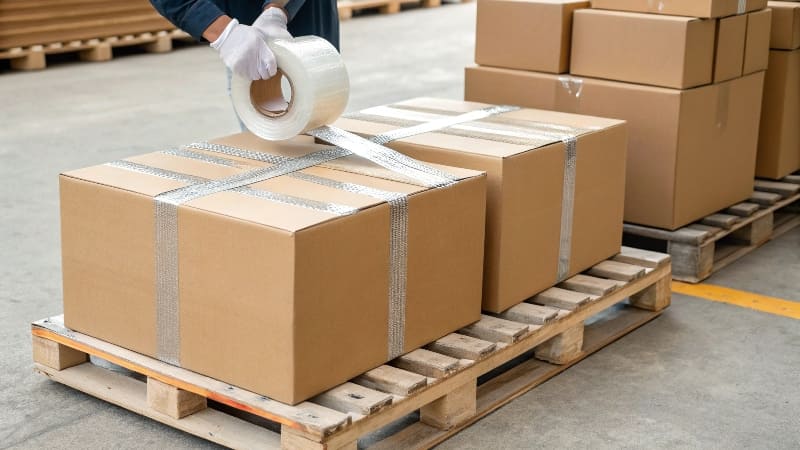
Reinforce a shipping box by using stronger materials like double-wall cardboard2. You can also add structural supports like cardboard corner inserts3 and apply strong, pressure-sensitive packing tape4 using the H-taping method5.
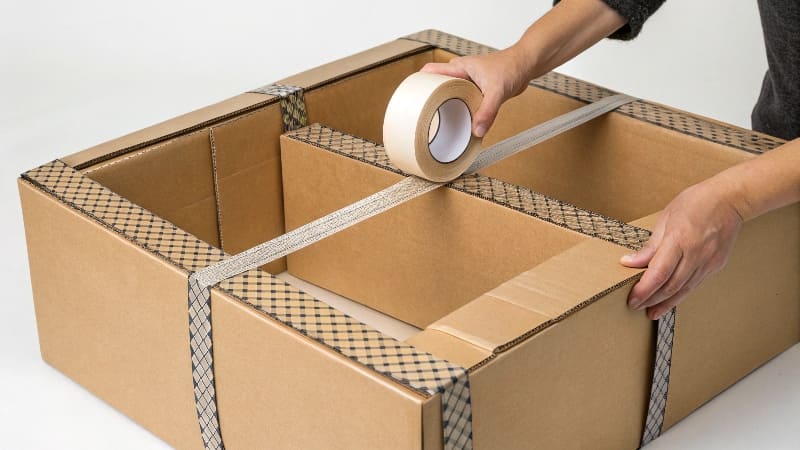
The best reinforcement starts with choosing the right material from the beginning. First off, make sure the box has an adequate strength rating1 for whatever you’re sending (First off, make sure the box has an adequate [strength rating](https://wansapackaging.com/why-are-custom-favour-boxes-important-for-gift-packaging/)1 for whatever you’re sending.). For corrugated boxes, this is usually measured by an Edge Crush Test (ECT) rating. A higher ECT means the box can withstand more stacking pressure. For a standard 10-20 pound shipment, an ECT of 32 is common. For heavier or more fragile items6, you should upgrade. The easiest upgrade is moving from a single-wall box to a double-wall box. This adds a whole second layer of that wavy, protective fluting, making the box significantly more rigid and puncture-resistant. For extra security, especially with heavy, squarish items, internal reinforcements like corner protectors can make a huge difference in preventing a box from collapsing if dropped on its edge.
Choosing Your Box Strength
| Material | Best For | Protection Level |
|---|---|---|
| Single-Wall (32 ECT) | Lightweight items under 20 lbs | Standard |
| Double-Wall (44+ ECT) | Heavy or fragile items6, international shipping | High |
| Internal Reinforcements | Adding rigidity to prevent crushing | Maximum |
How to secure boxes for shipping?
You’ve found a box that your product fits in, but it's rattling around inside. All that empty space is just an invitation for your product to get damaged during its journey.
Secure a box by choosing the smallest possible size that still allows for protective padding. Fill all empty space with void fill7 to stop any movement, and seal all seams with strong packing tape.
<sup id=](https://wansapackaging.com/wp-content/uploads/2025/09/how-to-secure-boxes-for-shipping-y.jpg) 7." title="Securing a Product Inside a Box" />
7." title="Securing a Product Inside a Box" />
This is one of the most important tips I give my clients. You need to find the smallest box possible for your item that will allow for protective padding if needed (find the smallest box possible for your item that will allow for protective padding if needed.). An item that can't move can't break. Aim for about two inches of space around your product for cushioning. Then, you must fill every single gap. Air is your enemy. The second crucial part is sealing. Make sure you have enough tape on there (make sure you have enough tape on there.). Use strong, pressure-sensitive packing tape4—not masking tape or craft tape. Don't rely on the clerk at the post office to tape it for you so that you’ll be happy with the job (Don’t rely on the clerk at the post office to tape it for you so that you’ll be happy with the job.). Take control and use the H-taping method5: tape down the center seam where the flaps meet, and then tape along the two side seams. This creates a secure seal that reinforces the box's structure.
Common Void Fill Options
| Void Fill Type | Pros | Cons |
|---|---|---|
| Bubble Wrap | Excellent cushioning, versatile | Plastic waste, can be bulky |
| Air Pillows | Lightweight, good for blocking | Can pop, poor for sharp corners |
| Packing Paper | Recyclable, good for bracing | Can compress, less cushioning |
| Custom Inserts | Perfect fit, professional look | Higher upfront cost |
How to properly ship a box?
Your box is packed and sealed, but you have a feeling you're missing a final, crucial step. A simple mistake with a label or form can cause major shipping delays8 or even a lost package.
To properly ship a box, place a clear shipping label9 flat on the largest top surface, away from any seams or edges. Remove all old labels to avoid confusion and double-check your documentation.
<sup id=](https://wansapackaging.com/wp-content/uploads/2025/09/how-to-properly-ship-a-box-your-bo.jpg) 9 placed flat on top." title="Properly Labeled Shipping Box" />
9 placed flat on top." title="Properly Labeled Shipping Box" />
The final steps are just as important as the packing itself. Your shipping label9 is your package's passport. It needs to be completely flat and scannable. Never wrap it around a corner or place it over a seam where it could get torn. Always remove or completely cover up any old shipping label9s or barcodes—automated sorting machines10 can get confused and send your package to the wrong place. And while it can be tempting to cover your box in "Fragile" stickers, you should know that they are not a guarantee of special handling. Your box must be packed well enough to survive a normal journey, including drops and tumbles. Think of those stickers as a polite request, not a shield. The real shield is the quality of your packing job.
How to ship a fragile box?
You're about to ship something delicate and breakable, and you're terrified. You're imagining it arriving in a million pieces, creating an angry customer and a costly mess for your brand.
To ship a fragile box, use the "box-in-box" method. Pack your item securely in a small inner box, then place that box inside a larger, sturdier shipping box with at least two inches of cushioning.
<sup id=](https://wansapackaging.com/wp-content/uploads/2025/09/how-to-ship-a-fragile-box-you-re-a.jpg) 11 for shipping [fragile items](https://wansapackaging.com/how-to-make-sure-my-boxes-are-sturdy-while-shipping-them/)6." title="Box-in-Box Shipping Method" />
11 for shipping [fragile items](https://wansapackaging.com/how-to-make-sure-my-boxes-are-sturdy-while-shipping-them/)6." title="Box-in-Box Shipping Method" />
For anything truly fragile, the box-in-box method11 is the professional gold standard. It creates a suspension system that absorbs shock and protects your item from impact. Here’s how you do it. First, wrap your fragile item in bubble wrap12 and place it in a small, snug-fitting inner box. Fill any small gaps so the item can't move at all inside this first box. Next, get a larger, sturdy shipping box that's at least four to six inches wider, longer, and taller than your inner box. Pour a two-to-three-inch layer of cushioning material13, like packing peanuts14 or crumpled paper, on the bottom of the large box. Place your sealed inner box on top of that layer, right in the center. Then, fill all the remaining space on the sides and top with more cushioning. The inner box should be "floating" in padding. Once sealed, give it a gentle shake. If you can hear or feel anything shifting, you need to open it and add more padding.
Conclusion
A sturdy box is a system, not a single product. It’s the right box material, the right size, the right internal packing15, and the right sealing method all working together.
Understanding strength ratings helps ensure your products are protected during transit, reducing damage and returns. ↩
Double-wall cardboard offers superior protection for fragile items, making it essential for safe shipping. ↩
Cardboard corner inserts provide additional support, preventing damage during shipping and ensuring product safety. ↩
This type of tape creates a strong seal, ensuring your box remains secure throughout its journey. ↩
The H-taping method reinforces box structure, providing extra security against opening during transit. ↩
Learn the best practices for packing fragile items to ensure they arrive safely and intact. ↩
Choosing the right void fill prevents movement and damage, ensuring your product arrives intact. ↩
Understanding common causes of shipping delays can help you take proactive measures to ensure timely delivery. ↩
Proper label placement ensures your package is easily scannable, reducing the risk of shipping delays. ↩
Knowing how these machines operate can help you package your items correctly to avoid misdelivery. ↩
This method provides superior protection for delicate items, minimizing the risk of damage during transit. ↩
Bubble wrap offers excellent cushioning, protecting fragile items from impact during shipping. ↩
Selecting the right cushioning material is crucial for protecting items from shocks and impacts. ↩
Packing peanuts are effective for cushioning and preventing movement, ensuring safe delivery of your products. ↩
Effective internal packing is essential for preventing damage and ensuring products arrive in perfect condition. ↩
More to read
# Which is Better for Packaging Mockups: Laser or Inkjet?
Which is Better for Packaging Mockups: Laser or Inkjet? You need to create a physical
2025 year the most welcome packaging box color trends
This year, packaging trends are making a bold statement with Radiant Red taking the limelight
5 Important Things to Consider for Luxury Products Packaging?
5 Important Things to Consider for Luxury Products Packaging? You've created a premium product, but