

Custom Packaging Solutions
Premium quality packaging tailored to your brand. From cosmetic boxes to luxury rigid packaging, we deliver excellence since 2010.
This is the title

Hey there, I'm Mike!
How to make custom cube box1es?
You need a unique cube box for your product, but the professional manufacturing process seems daunting. DIY attempts often look flimsy and unprofessional, failing to properly represent your brand's quality.
Making a professional custom cube box1 involves designing a digital dieline2, choosing the right material, printing your graphics, and then using industrial machines3 for precise cutting, creasing, folding, and gluing. For a simple prototype, you just need cardboard, a ruler, and glue.
<sup id=](https://wansapackaging.com/wp-content/uploads/2025/10/how-to-make-custom-cube-boxes-you-n.jpg) 1 next to a handmade [cardboard cube](https://www.youtube.com/watch?v=kbNPzIkdgQs)4 prototype." title="Professional vs. DIY Custom Cube Box" />
1 next to a handmade [cardboard cube](https://www.youtube.com/watch?v=kbNPzIkdgQs)4 prototype." title="Professional vs. DIY Custom Cube Box" />
A cube is the perfect starting point for packaging—it's strong, simple, and efficient. As the founder of Wansa Packaging, I've seen millions of them made. But understanding how a cube is made, from a simple home prototype to a mass-produced unit, is key to appreciating the entire world of custom packaging. And sometimes, the best solution for your product isn't a cube at all, which opens up a whole new world of creative possibilities.
How to make a cube with cardboard step by step?
You want to create a physical box prototype right now. But without the right tools, your cuts are uneven and the folds are messy, making your idea look unprofessional.
To make a cardboard cube4, draw a cross shape with six equal squares on cardboard. Add small tabs to the edges for gluing. Carefully cut it out with a craft knife5, score the fold lines with a ruler, fold it into a cube, and glue the tabs inside.
<sup id=](https://wansapackaging.com/wp-content/uploads/2025/10/how-to-make-a-cube-design-for-manufa.jpg) 5 and ruler." title="Making a Cardboard Cube Prototype Step by Step" />
5 and ruler." title="Making a Cardboard Cube Prototype Step by Step" />
Creating a mock-up6 by hand is a crucial first step for any designer like Jacky. It helps you get a feel for the size and proportions before committing to a full production run. This DIY method is purely for creating a physical sample for testing or presentation, not for creating a final product to sell. For a clean prototype, you need precision.
Simple Steps for a DIY Cube Prototype
- Measure and Draw: On a piece of cardstock or thin cardboard, use a pencil and ruler to draw a net of your cube. This looks like a cross shape made of six identical squares. Four squares are in a line vertically, with one square attached to the left and right of the second square from the top.
- Add Gluing Tabs: Draw small, angled tabs on the outer edges of three of the squares. These will be used to glue the box together from the inside.
- Cut and Score: Use a sharp craft knife5 and a metal ruler to carefully cut out the entire shape. Then, lightly score all the interior fold lines. Scoring means pressing a dull edge along the line to create a clean crease, which makes folding much easier and cleaner.
- Fold and Glue: Carefully fold along all your scored lines. Apply a thin layer of strong craft glue to the tabs and tuck them inside, pressing the walls of the cube together until the glue sets.
How to make a cube design for manufacturing?
Your prototype looks great, but now you need thousands of them made perfectly. Sending a simple drawing to a factory will cause communication errors, delays, and costly mistakes.
A professional cube design requires creating a digital vector dieline file, usually in Adobe Illustrator. This file includes precise cut lines, crease lines, and bleed7 margins. Your branding is then placed on a separate layer that aligns perfectly with this structural dieline.
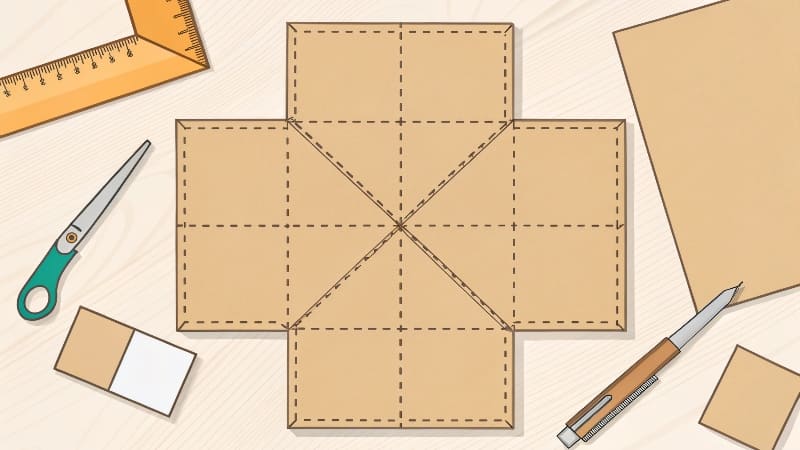
When you move from a single prototype to mass production, everything has to be digital and precise. At Wansa Packaging, we can't use a physical model to set up our machines. We need a digital blueprint, which is called a dieline. This is the single most important file in the entire production process. A designer provides this file, and it contains all the information our machines need to create the final box perfectly every single time.
Key Elements of a Dieline File
- Vector Format: The file must be a vector file (like an AI or PDF from Adobe Illustrator). This allows it to be scaled to any size without losing quality.
- Line Types: The dieline uses different line styles to communicate different actions to the machinery. A solid line typically means "cut," while a dashed line means "crease" or "fold."
- Graphic Design Layer: The artwork, logos, and text are placed on a separate layer in the design file. This allows us to check the structural design and the graphic design independently.
- Bleed: Your designer must add a "bleed7," which is extra color or imagery that extends beyond the cut lines. This ensures there are no accidental white edges on the final box if the cut is off by a fraction of a millimeter.
What are some popular alternatives to cube boxes?
Your product is unique, but a standard cube box can make it feel ordinary. In a sea of square packaging on a retail shelf, you risk being completely overlooked by your target customers.
Cylinder boxes, or paper tubes, are a popular alternative. They offer a unique, premium feel8 that customers love and can be made from paper or plastic, providing a great way to showcase candles, bottles, or cosmetic products.
<sup id=](https://wansapackaging.com/wp-content/uploads/2025/10/what-are-some-popular-alternatives-t.jpg) 9 for different products like cosmetics and candles." title="Popular Alternatives to Cube Boxes: Cylinders" />
9 for different products like cosmetics and candles." title="Popular Alternatives to Cube Boxes: Cylinders" />
While cubes are functional, they are not always the most exciting shape. One of the most popular alternatives I recommend to clients is the cylinder box. In my experience, European and American customers especially like to use cylinder gift boxes to package products. The cylinder shape is just more appealing and feels more special to customers . They stand out on the shelf and provide a completely different unboxing experience10.
I also often suggest cylinder boxes9 because they are another fantastic style of gift box packaging. They usually consist of a cylinder body and a lid, and can be a transparent packaging format, which is convenient for a clearer display of the product . This is perfect for products where the customer wants to see the item inside, like a beautiful candle or a bottle of serum. They can be made from clear plastic (like PVC) or from high-quality rolled paperboard for a more eco-friendly and sturdy feel.
Conclusion
From a simple DIY cube to professionally manufactured cylinders, understanding packaging construction11 and design options is the first step to creating the perfect box for your unique brand and product.
Explore expert resources to elevate your custom cube box design and manufacturing process. ↩
Learn how to create a precise digital dieline to ensure your packaging is professional and accurate. ↩
Discover the industrial machines that ensure precision in box manufacturing and enhance production quality. ↩
Find detailed guides on crafting a cardboard cube for prototypes and DIY projects. ↩
Check out recommendations for craft knives that provide clean cuts for your cardboard projects. ↩
Understand the significance of mock-ups in design to visualize and test your ideas effectively. ↩
Discover the importance of bleed in graphic design to avoid unwanted white edges on your packaging. ↩
Learn strategies to design packaging that conveys a premium feel and attracts customers. ↩
Find out why cylinder boxes are a popular choice for packaging and how they can enhance product appeal. ↩
Explore elements that contribute to a memorable unboxing experience, enhancing customer satisfaction. ↩
Understand the essential elements of packaging construction to create functional and attractive designs. ↩
More to read
# Which is Better for Packaging Mockups: Laser or Inkjet?
Which is Better for Packaging Mockups: Laser or Inkjet? You need to create a physical
2025 year the most welcome packaging box color trends
This year, packaging trends are making a bold statement with Radiant Red taking the limelight
5 Important Things to Consider for Luxury Products Packaging?
5 Important Things to Consider for Luxury Products Packaging? You've created a premium product, but