


Custom Packaging Solutions
Premium quality packaging tailored to your brand. From cosmetic boxes to luxury rigid packaging, we deliver excellence since 2010.
This is the title

Hey there, I'm Mike!
How do you write dimensions for length, width, and height?
You've measured your product, but now you're staring at a form asking for L x W x H. Listing the numbers in the wrong order can result in a box that's completely the wrong shape.
The universal standard is to write dimensions as Length x Width x Height (L x W x H). You must list the three measurements in this specific order, including the units like inches (in) or centimeters (cm).

As the founder of a packaging company, I've seen how this one simple rule can make or break a project. The L x W x H sequence is the language of our industry. It's not just a preference; it's a technical standard that ensures a designer in Canada and my production team in China are looking at the exact same imaginary box. When that language is clear, we create beautiful packaging. When it's not, we create confusion and waste.
What comes first, length or width or height?
You have your measurements, but you're unsure which one to call "Length." Getting the order wrong is a common and costly mistake, leading to packaging that simply doesn't fit.
Length always comes first. The standard industry format is Length, then Width, then Height (L x W x H). Length is the longest side of the box's opening when you look down at it.
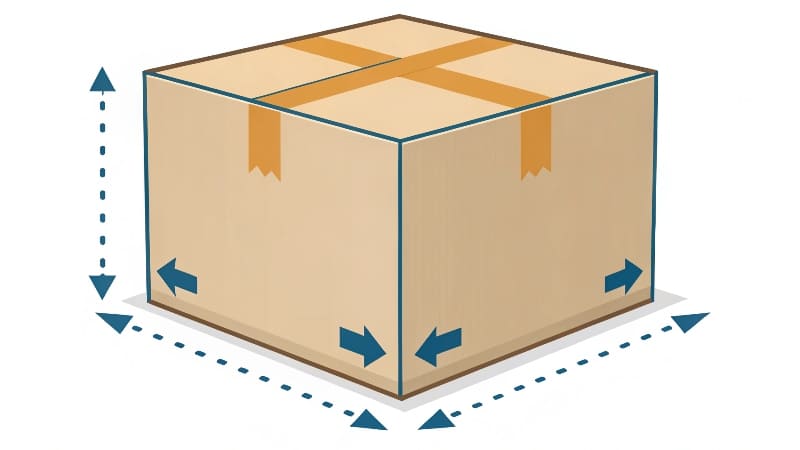
I always tell new clients to follow a simple process. In my experience, the order of length, width, and height is determined this way: length is the longest side, we find this first. Width is what we sometimes call thickness. Height is the vertical side when the box is standing up. These three sides determine the box's L, W, and H . This simple rule from the factory floor ensures we are always on the same page.
A Practical Step-by-Step Guide
To eliminate any confusion, follow these steps exactly when measuring a box:
- Place the box in front of you. Position it so the main opening is facing up.
- Identify the Length. Look down at the opening and find the longest side. This is your Length. Measure it.
- Identify the Width. Now look at the shorter side of the opening. This is your Width. Measure it.
- Identify the Height. Finally, measure the depth of the box from top to bottom. This is your Height.
If a box has a square opening (where Length and Width are equal), the first two numbers will be the same. For example, a perfect cube would be 10cm x 10cm x 10cm.
What is the meaning of W x D x H?
You receive a specification sheet for a cabinet that lists dimensions as W x D x H. This different order can be confusing and make you question all your previous assumptions.
W x D x H stands for Width x Depth x Height. It's an alternative format commonly used for items like furniture or appliances where 'Depth' (front to back) is more intuitive than 'Length'.
While L x W x H is the standard for packaging and shipping, other industries have their own logical conventions. You'll often see W x D x H used for things that sit against a wall or have a clear "front." The key is to understand what each term means in context.
Comparing the Two Standards
| Standard | Full Term | L / W Means... | W / D Means... | H Means... | Commonly Used For |
|---|---|---|---|---|---|
| L x W x H | Length x Width x Height | Longest side of opening | Shorter side of opening | Vertical dimension | Boxes, Packaging, Shipping |
| W x D x H | Width x Depth x Height | Side-to-side dimension | Front-to-back dimension | Vertical dimension | Furniture, Cabinets, Appliances |
The important thing is that Height (H) almost always comes last. In the W x D x H format, Width is the measurement across the front of the item, and Depth is how far it goes back. W takes the place of L as the first measurement, and D takes the place of W as the second. When in doubt, always ask for clarification.
What is the correct way to write measurements?
You've listed the numbers in the right order but forgot the units. Now your supplier is asking if you meant 12 inches or 12 centimeters, causing a delay in your project.
The correct way is to list the numbers in L x W x H order, followed by the unit of measurement. For example, 12 in x 8 in x 4 in or 30cm x 20cm x 10cm.
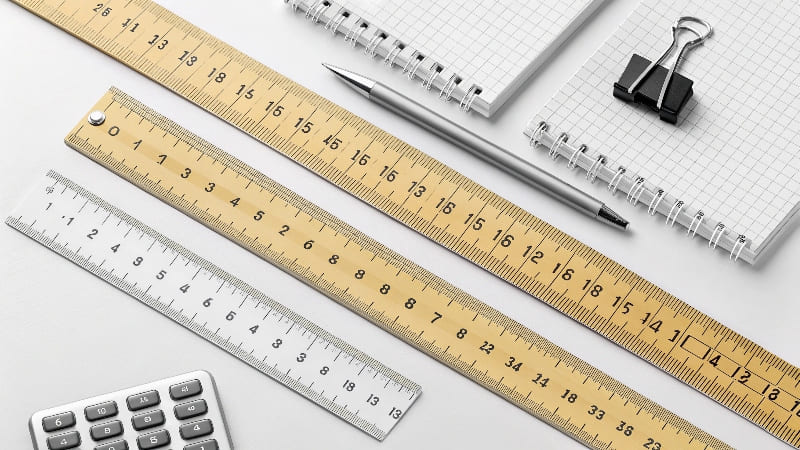
Being specific is the most important part of my job. A single missing detail can throw off an entire production run. When you're writing measurements, more detail is always better than less. Clarity prevents mistakes, saves money, and gets your project completed faster. To avoid any problems, I always tell my clients to follow a simple checklist when providing their dimensions.
Best Practices for Writing Dimensions
- Use the Right Order: Always start with Length x Width x Height.
- Include Units: Clearly state
in,cm,mm, etc., after each number. Don't assume the reader knows which unit you're using. - Be Consistent: Don't mix units. If you start with inches, use inches for all three dimensions.
- Specify Internal or External: For packaging, we usually need the internal dimensions to ensure your product fits. Specify "ID" (Internal Dimensions) or "OD" (External Dimensions) if it's not obvious. For example:
12cm x 10cm x 5cm (ID). - Use "x" as a Separator: The "x" is read as "by" and is the standard separator. Using other symbols like commas or dashes can cause confusion.
A perfectly written dimension looks like this: L 12 in x W 8 in x H 4 in. It leaves zero room for error.
Do you write height or width first?
You're in a hurry and you jot down the height before the width. This common slip-up can lead to a manufacturer producing a box that is tall and skinny instead of short and wide.
You always write Width before Height. The second number in the L x W x H sequence is Width, and the third and final number is always Height. This order is a strict industry rule.
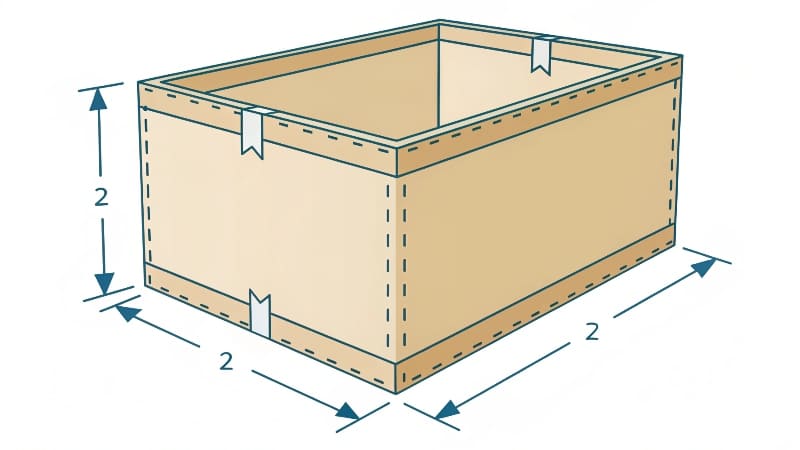
I have a story about this. A client once sent us an order for a luxury cosmetic box with dimensions 8cm x 12cm x 4cm. They had accidentally swapped the Length and Width and put the Height in the middle. They wanted a box that was 12cm x 8cm x 4cm (L x W x H). Because of the mix-up, the first sample we produced was a box that was 8cm long, 12cm wide, and 4cm high. It was wider than it was long, which looked strange and didn't fit their product correctly. Luckily, we caught this at the sample stage, but it still caused a week-long delay. This is a perfect example of why the sequence matters so much. A simple transposition of two numbers creates a completely different object. Following the L x W x H rule prevents this kind of avoidable, costly error.
Conclusion
To write dimensions correctly, always follow the universal rule: Length x Width x Height, and always include your units. This simple habit will ensure clarity and prevent costly manufacturing mistakes.
More to read
# Which is Better for Packaging Mockups: Laser or Inkjet?
Which is Better for Packaging Mockups: Laser or Inkjet? You need to create a physical
2025 year the most welcome packaging box color trends
This year, packaging trends are making a bold statement with Radiant Red taking the limelight
5 Important Things to Consider for Luxury Products Packaging?
5 Important Things to Consider for Luxury Products Packaging? You've created a premium product, but
