


Custom Packaging Solutions
Premium quality packaging tailored to your brand. From cosmetic boxes to luxury rigid packaging, we deliver excellence since 2010.
This is the title

Hey there, I'm Mike!
How are dimensions listed for custom boxes?
You're ready to order custom boxes, but the dimension format is confusing. You're worried that one simple mistake in the order will result in thousands of boxes that are completely the wrong shape.
Dimensions for boxes are listed in the industry-standard order of Length1h x Width x Height (L x W x H)](2ging.com/how-to-read-box-dimensions-a-guide-to-box-packaging/)%%%FOOTNOTE_REF_3">https://wansapackaging.com/how-to-read-box-dimensions-a-guide-to-box-packaging/)2ging.com/how-to-read-box-dimensions-a-guide-to-box-packaging/)%%%FOOTNOTE_REF_3%%% x Height4 (L x W x H). These measurements typically refer to the interior space of the assembled box to ensure a proper product fit.
<sup id=](https://wansapackaging.com/wp-content/uploads/2025/10/how-are-dimensions-listed-for-custom-.jpg) 1, [Width](https://wansapackaging.com/how-to-read-box-dimensions-a-guide-to-box-packaging/)3, and [Height](https://wansapackaging.com/how-to-read-box-dimensions-a-guide-to-box-packaging/)4 dimensions." title="Standard Box Dimensions L x W x H" />
1, [Width](https://wansapackaging.com/how-to-read-box-dimensions-a-guide-to-box-packaging/)3, and [Height](https://wansapackaging.com/how-to-read-box-dimensions-a-guide-to-box-packaging/)4 dimensions." title="Standard Box Dimensions L x W x H" />
In all my years in the packaging industry, from my first job in a factory to founding Wansa Packaging, I have seen this one simple detail cause the biggest headaches. A client might accidentally swap the width and height, and suddenly their tall, skinny bottle won't fit into the short, wide box they received. This isn't just a small mistake; it's a costly disaster that can delay a product launch. Understanding this simple L x W x H rule is the most fundamental piece of knowledge you need. Let's make sure you get it right so you can order with total confidence.
What comes first, length or width or height?
You're looking at your product and the box diagram, but it's not obvious which side is which. Guessing the order incorrectly could mean your product simply will not fit into the final box.
Length1 always comes first. The standard global format is Length1 (L) x Width3 (W) x Height4 (H). For a box, the length is the longest side of the top opening.
<sup id=](https://wansapackaging.com/wp-content/uploads/2025/10/what-comes-first-length-or-width-or-1.jpg) 1" and the shorter side labeled "[Width](https://wansapackaging.com/how-to-read-box-dimensions-a-guide-to-box-packaging/)3"." title="Identifying [Length](https://wansapackaging.com/how-do-i-correctly-understand-length-width-and-height/)1 and [Width](https://wansapackaging.com/how-to-read-box-dimensions-a-guide-to-box-packaging/)3 of a Box" />
1" and the shorter side labeled "[Width](https://wansapackaging.com/how-to-read-box-dimensions-a-guide-to-box-packaging/)3"." title="Identifying [Length](https://wansapackaging.com/how-do-i-correctly-understand-length-width-and-height/)1 and [Width](https://wansapackaging.com/how-to-read-box-dimensions-a-guide-to-box-packaging/)3 of a Box" />
This is the golden rule of packaging, and it's non-negotiable. I always explain to my team that for a gift box, we start calculating from the length, then the width, and finally the height . Let's define these terms clearly. Imagine you place a box on the table in front of you with the main opening facing up.
- Length1 (L): This is the longest of the two sides of the opening.
- Width3 (W): This is the shorter of the two sides of the opening. It is sometimes called "depth."
- Height4 (H): This is the dimension that goes up and down. It's the measurement from the bottom panel of the box to the top.
Think of it this way: length is the longest side, width is the side edge, and height is the height. Sticking to this order ensures that everyone, from a designer like Jacky in Canada to our manufacturing team in China, is speaking the same language.
How should I list dimensions?
You have your measurements, but you're not sure about the correct format to send your supplier. A simple typo or ambiguity could derail your entire project and waste your budget.
List dimensions as Length1 x Width3 x Height4, and always specify the units5 (e.g., inches or mm). Also, state if they are internal (ID) or external (OD) measurements. Example: 10" L x 8" W x 4" H (Internal).
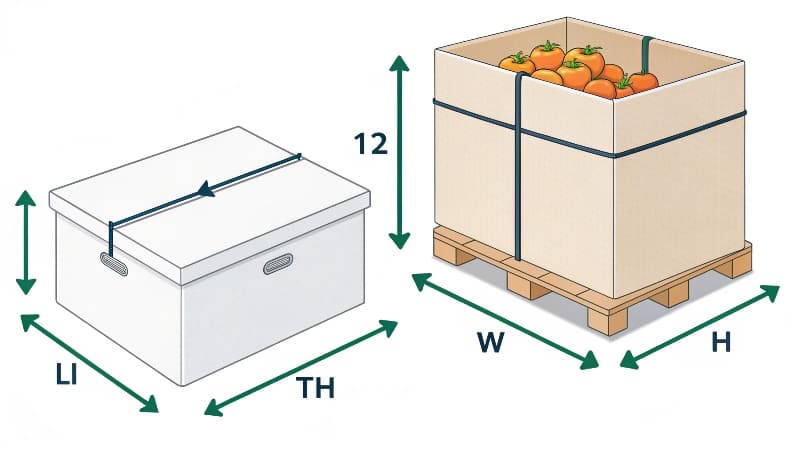
The format is absolutely critical. I can't stress this enough: the order of length, width, and height cannot be wrong; if it is, the box's structure will have problems. This isn't just a preference; it affects the physical manufacturing of the box. For example, in corrugated shipping boxes6, the direction of the paper's flutes (the internal wavy layer) is usually set to run parallel to the height for maximum stacking strength. If the dimensions are listed incorrectly, the flutes could be oriented the wrong way, creating a much weaker box that could get crushed during shipping.
To avoid any confusion, here is a simple checklist to use every time:
- Use the Correct Order: Always, always write Length1 x Width3 x Height4.
- Specify Your Units: Clearly state inches (“), millimeters (mm), or centimeters (cm).
- Define Measurement Type: Specify if your numbers are for the Internal Dimensions (ID)7 or External Dimensions (OD)8. ID is what matters for making sure your product fits inside. OD is important for shipping and pallet calculations. If you're unsure, provide the ID.
What does 12x169 mean?
You've seen a size listed with only two numbers, like "12x169". This is confusing because you know a box needs three dimensions, and you're left guessing what the measurement describes.
A two-number dimension like 12x169 almost always refers to a flat, two-dimensional item10 like a sheet of paper, a label, or a plastic bag. It typically represents Length1 x Width3.
<sup%20id=)
This is a frequent point of confusion, especially for people who are used to ordering flat promotional items and are now moving into custom boxes. The third number, Height4 (H), is what turns a flat plane into a three-dimensional object. If you don't see that third number, you are not looking at a standard box dimension.
| Item Type | Standard Format | Example | Meaning |
|---|---|---|---|
| Flat Item (Bag/Sheet) | Length1 x Width3 | 12" x 16" | A flat item, 12 inches on one side and 16 on the other. |
| 3D Item (Box) | Length1 x Width3 x Height4 | 12" x 10" x 4" | A box with three distinct dimensions. |
The absence of a third dimension is your biggest signal. While the order for a 2D item is less critical than for a box, the general convention is still to list the longer side first. However, if a potential supplier ever quotes you for a "box" using only two dimensions, you must stop and ask for clarification. They may have forgotten to add the height, but you can't afford to make that assumption.
How are dimensions listed in the UK?
You need to work with suppliers in different countries and worry that regional standards will cause a huge misunderstanding. A simple mix-up between inches and centimeters could be a disaster.
The UK uses the same Length1h x Width x Height (L x W x H)](2ging.com/how-to-read-box-dimensions-a-guide-to-box-packaging/)%%%FOOTNOTE_REF_3">https://wansapackaging.com/how-to-read-box-dimensions-a-guide-to-box-packaging/)2ging.com/how-to-read-box-dimensions-a-guide-to-box-packaging/)%%%FOOTNOTE_REF_3%%% x Height4 (L x W x H) order as the US and the rest of the world. The key difference is the unit of measurement: the UK uses the metric system11, primarily millimeters (mm).
This is fantastic news because it means the fundamental language of box shapes is global. The sequence of L x W x H is a true international standard. A box manufacturer in London will understand that order just as well as I do here in China. The only thing you need to be extremely careful about is the unit.
The United States still primarily uses the imperial system12 (inches). The UK, Europe, and Asia all use the metric system11. For the precision required in packaging, millimeters (mm) are the standard.
Here is the most important conversion to know: 1 inch = 25.4 millimeters13
When you send dimensions to an international supplier like us, the safest practice is to provide them in millimeters. If you only work in inches, that's okay, but you must clearly label them. For example, write "10 in. x 8 in. x 4 in." or "10" x 8" x 4". This prevents a supplier from ever assuming "10" means 10mm when you actually mean 254mm. Being explicit with your units is just as crucial as getting the order right.
Conclusion
Always list your box dimensions in the order of Length1 x Width3 x Height4. Mastering this simple industry standard is the key to clear communication and getting the perfect custom box.
Clarifying the definition of Length is crucial for accurate box measurements and product fit. ↩
Understanding the standard format ensures accurate orders and prevents costly mistakes in packaging. ↩
Understanding Width helps avoid mix-ups when ordering custom boxes for your products. ↩
Knowing the correct Height measurement is essential for ensuring your products fit properly. ↩
Specifying units prevents confusion and ensures accurate communication with suppliers. ↩
Learning about corrugated boxes helps in selecting the right packaging for shipping needs. ↩
Understanding ID is vital for ensuring your products fit inside the boxes correctly. ↩
Knowing OD is important for shipping and logistics calculations. ↩
Clarifying this term helps avoid confusion when ordering flat items versus boxes. ↩
Understanding the difference between 2D and 3D items is crucial for accurate orders. ↩
Understanding the metric system is essential for accurate measurements in global packaging. ↩
Knowing the differences between metric and imperial systems helps prevent costly errors. ↩
This conversion is crucial for accurate communication of dimensions across different measurement systems. ↩
More to read
# Which is Better for Packaging Mockups: Laser or Inkjet?
Which is Better for Packaging Mockups: Laser or Inkjet? You need to create a physical
2025 year the most welcome packaging box color trends
This year, packaging trends are making a bold statement with Radiant Red taking the limelight
5 Important Things to Consider for Luxury Products Packaging?
5 Important Things to Consider for Luxury Products Packaging? You've created a premium product, but
