

Custom Packaging Solutions
Premium quality packaging tailored to your brand. From cosmetic boxes to luxury rigid packaging, we deliver excellence since 2010.
This is the title

Hey there, I'm Mike!
You bake amazing cookies with different flavors2, but they all go into the same generic box. Customers can't tell your chocolate chip from your oatmeal raisin, making your unique creations feel forgettable.
Yes, different cookies absolutely need different packaging boxes. This helps with brand identity3, protects varied textures4, allows customers to distinguish flavors2, and creates a unique experience5 for each product.
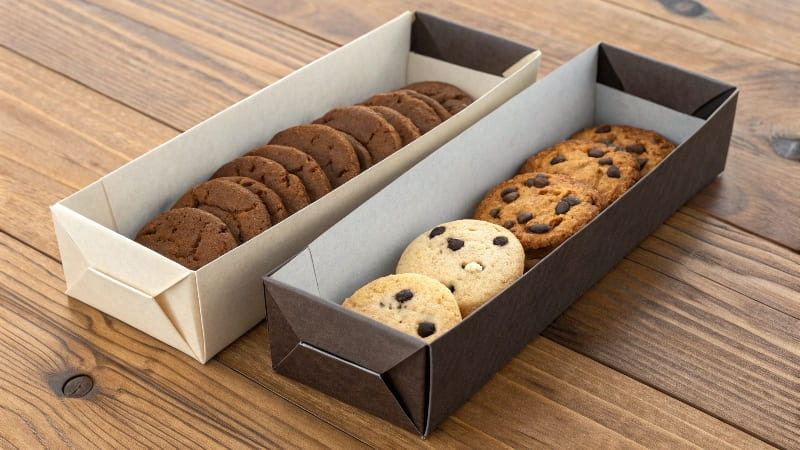
From my years in the packaging business, I've seen how the right box can transform a simple cookie into a must-have treat. I think using different printing designs and graphics6 for different cookies is a huge benefit for product promotion . Why? Because customers can decide which cookies to buy simply by looking at the printed pattern on the gift box . A fun, colorful box for a sprinkle cookie and an elegant, dark box for a double fudge cookie tell two different stories. Using the same box for both is a huge missed opportunity to connect with your customer before they even take the first bite.
You're trying to choose a box for your cookies, but the options are overwhelming. You're worried a flimsy bag will lead to broken cookies, while an expensive box might kill your profit margin.
The best packaging depends on the cookie and its purpose. Rigid boxes are best for premium gifts7, paperboard boxes are great for retail, and tin-tie bags are perfect for casual, fresh-from-the-bakery sales.
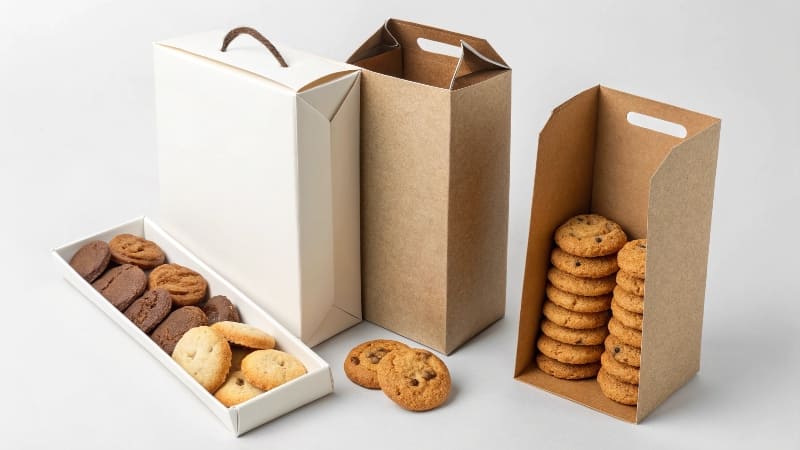
When clients ask me this, I always give them the same advice. Generally, for food packaging boxes, we recommend using paperboard or rigid gift boxes . There's a simple reason why. They are convenient to carry and also perfect for giving to others as a gift . The choice really signals the cookie's value. A durable, beautiful rigid box says "special occasion," while a well-designed paperboard box is perfect for catching a customer's eye on a store shelf.
Choosing Your Cookie Packaging
| Packaging Type | Best For | Key Advantage |
|---|---|---|
| Rigid Box | Luxury gifts, holiday sets | High perceived value, maximum protection |
| Paperboard Box | Retail sales, dozen-packs | Great for printing, cost-effective |
| Tin or Window Bag | In-store bakery sales | Shows off the cookie, feels fresh |
| Metal Tin | Keepsakes, corporate gifts | Reusable, excellent for freshness |
You shipped a batch of your beautiful, frosted sugar cookies, but they arrived as a crumbled mess. Your customer is upset, and you've lost both product and credibility.
Protective packaging for cookies almost always involves custom-fit trays or dividers8. These inserts, made from food-safe paperboard or plastic, hold each cookie individually to prevent them from breaking or smudging.
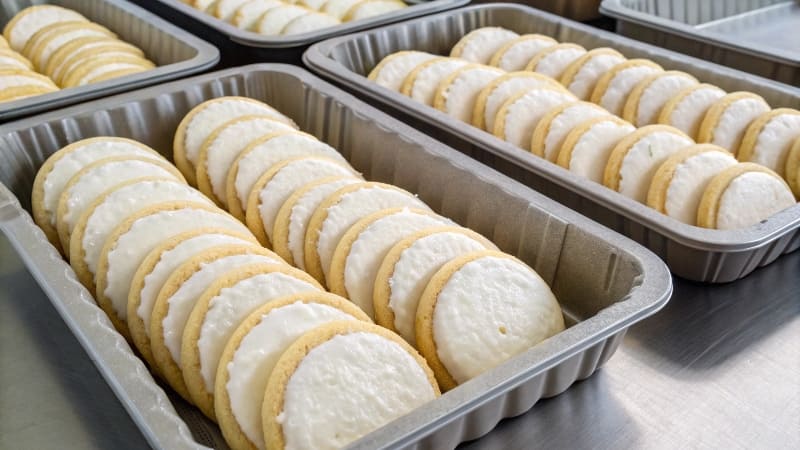
The number one enemy of a shipped cookie is movement. The number two enemy is air. Protective inserts solve both problems. When I work with a bakery client, we design the box and the insert at the same time. The insert is just as important as the outer box. Its job is to cradle each cookie so it can't rattle against its neighbor. This is crucial for delicate cookies with soft icing or brittle textures. The inserts can be simple paperboard dividers, fluted paper cups like those for cupcakes, or molded plastic trays where each cookie has its own perfectly shaped compartment. Not only does this protect the cookie, but it also presents them beautifully when the customer opens the box. It’s a functional solution that creates a very professional impression.
You need to order boxes for a dozen cookies, but you have no idea what dimensions to ask for. Guessing wrong means you'll end up with boxes that are either too small or wastefully large.
The box size depends entirely on your cookie's diameter and thickness. For twelve standard 3-inch cookies laid flat, a 9x7x2.5-inch box is a common starting point, but you must always measure your specific product.
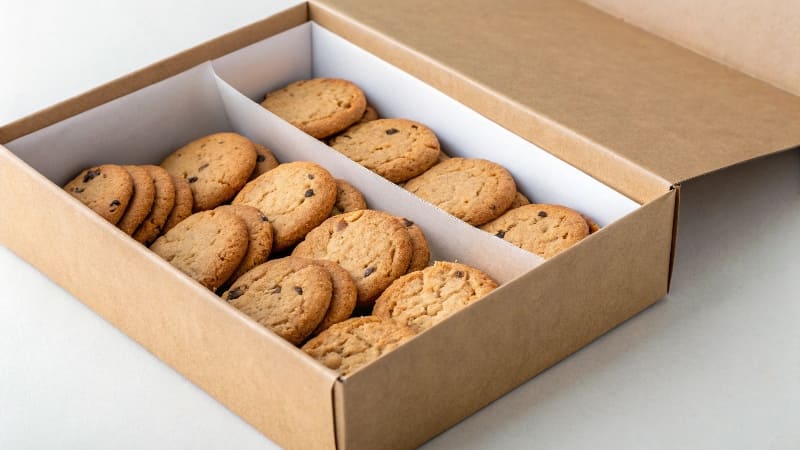
There's a simple process I walk my clients through, and it removes all the guesswork. A designer like Jacky would do this before even starting his design. You can't design a house without knowing how big the rooms need to be. The same goes for a cookie box.
How to Find Your Perfect Box Size
- Measure Your Cookie: Get a ruler. Measure the widest part (diameter) and the thickest part (height) of your finished cookie. Let's say your cookie is 3 inches wide and 0.5 inches thick.
- Plan the Layout: How will 12 cookies fit? A common layout is two rows of six (2x6) or three rows of four (3x4). A 2x6 layout would need space for two cookies side-by-side.
- Calculate and Add a Buffer: For a 2x6 layout of 3-inch cookies, you'd need a width of at least 6 inches and a length of at least 9 inches (if they are stacked in two layers). Always add a small buffer, about 1/8 inch, for an insert or a little wiggle room. So your internal dimensions might be 6.25 inches wide and 9.25 inches long. For the height, if two cookies are stacked (0.5 + 0.5 inches), you'll need at least 1 inch, plus buffer.
You've designed the perfect cookie box, and now you need to ship them to stores. You're not sure how to pack them into a larger case, and you're worried about damage during transit.
The number of cookie boxes per case typically ranges from 12 to 48, depending on your box size. The main goal is to pack them into a larger shipping carton9 (master case10) so tightly that nothing moves.
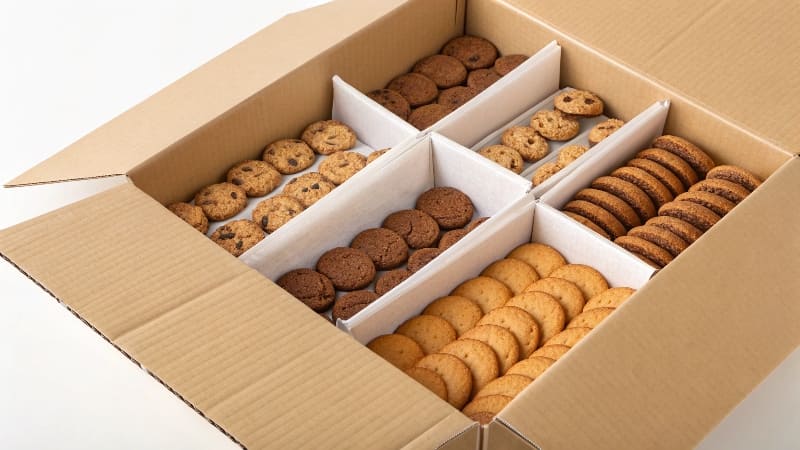
This is a question about logistics, and it's incredibly important. I've seen clients lose a whole shipment because their master case10s were packed poorly. When you ship your products to a retailer or distribution center, they travel in a larger, plain brown shipping box. This is your tertiary packaging. The goal is to figure out how to arrange your cookie boxes inside that larger case for maximum efficiency and safety. You want zero empty space. An empty space allows the boxes inside to shift, slam into each other, and get damaged. We work with our clients to find the perfect configuration. For example, we might find that 24 of their cookie boxes fit perfectly into a standard 18x12x12 inch master carton when laid flat. This calculation prevents damage and can even save you money on shipping.
Conclusion
Yes, different cookies need different boxes. Tailoring your packaging to each cookie type is a smart strategy to improve branding, protect your product, and create a better experience for your customers.
Explore how tailored packaging enhances brand identity and customer experience. ↩
Explore how unique packaging can help customers identify and choose flavors. ↩
Learn how effective packaging can strengthen your brand's presence in the market. ↩
Discover the importance of packaging in maintaining the quality of different cookie textures. ↩
Find out how unique packaging can elevate customer satisfaction and engagement. ↩
See how creative designs can attract customers and boost sales. ↩
Explore options for luxury packaging that enhances the perceived value of your products. ↩
Understand how protective inserts can prevent damage and enhance presentation. ↩
Learn about the logistics of packing cookie boxes for safe transit. ↩
Find out how to efficiently pack cookie boxes into larger shipping cases. ↩
More to read
# Which is Better for Packaging Mockups: Laser or Inkjet?
Which is Better for Packaging Mockups: Laser or Inkjet? You need to create a physical
2025 year the most welcome packaging box color trends
This year, packaging trends are making a bold statement with Radiant Red taking the limelight
5 Important Things to Consider for Luxury Products Packaging?
5 Important Things to Consider for Luxury Products Packaging? You've created a premium product, but